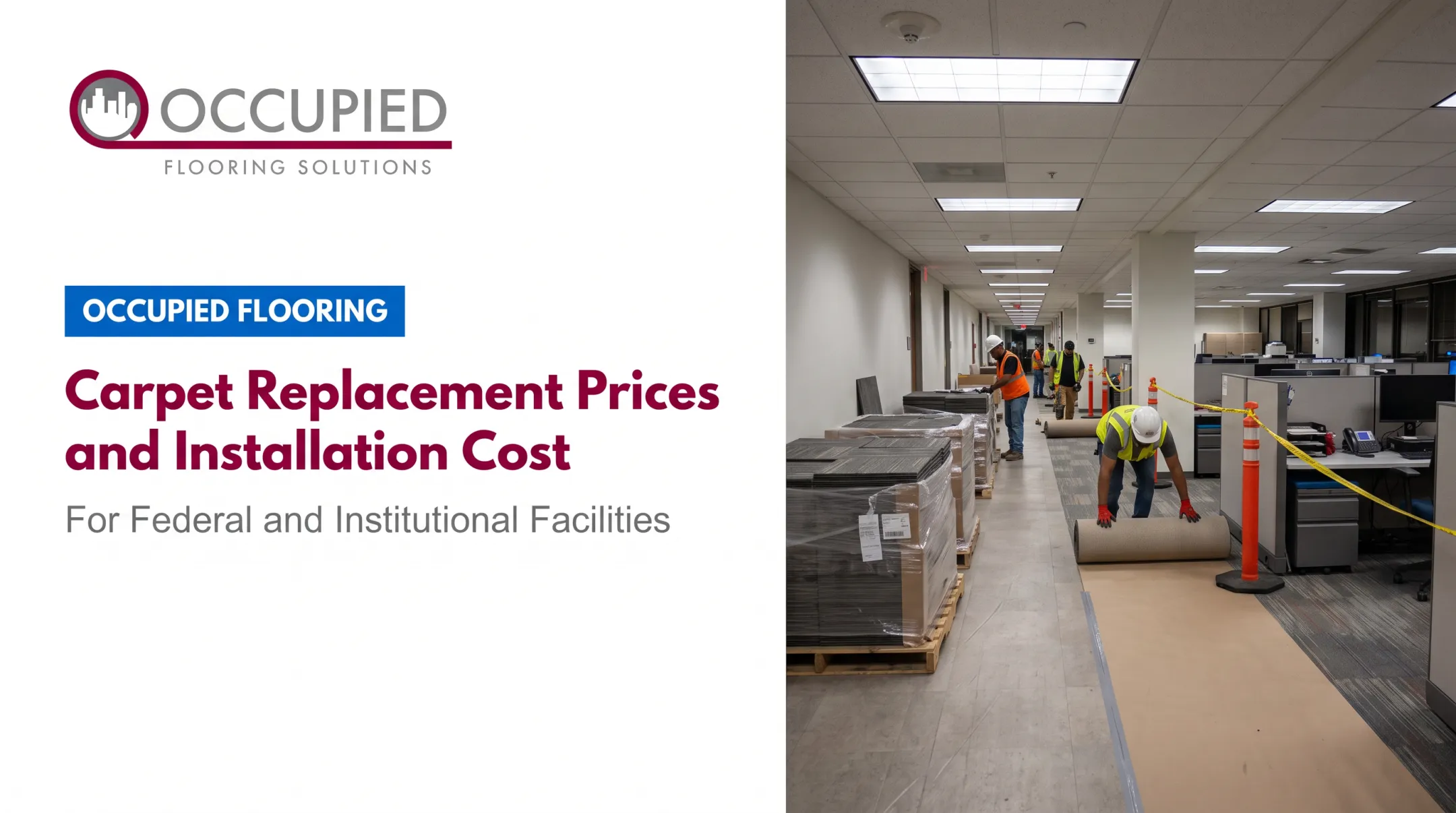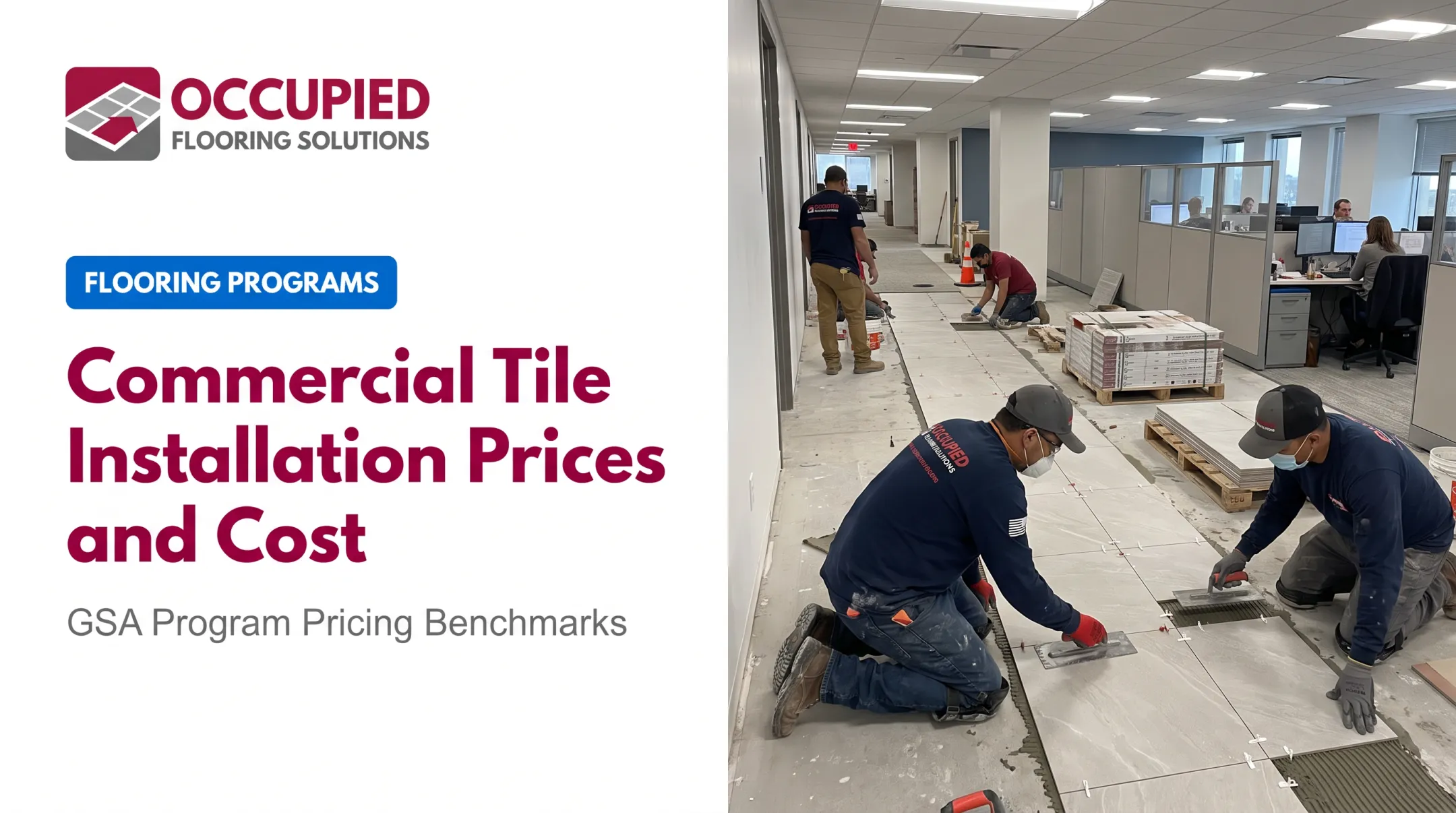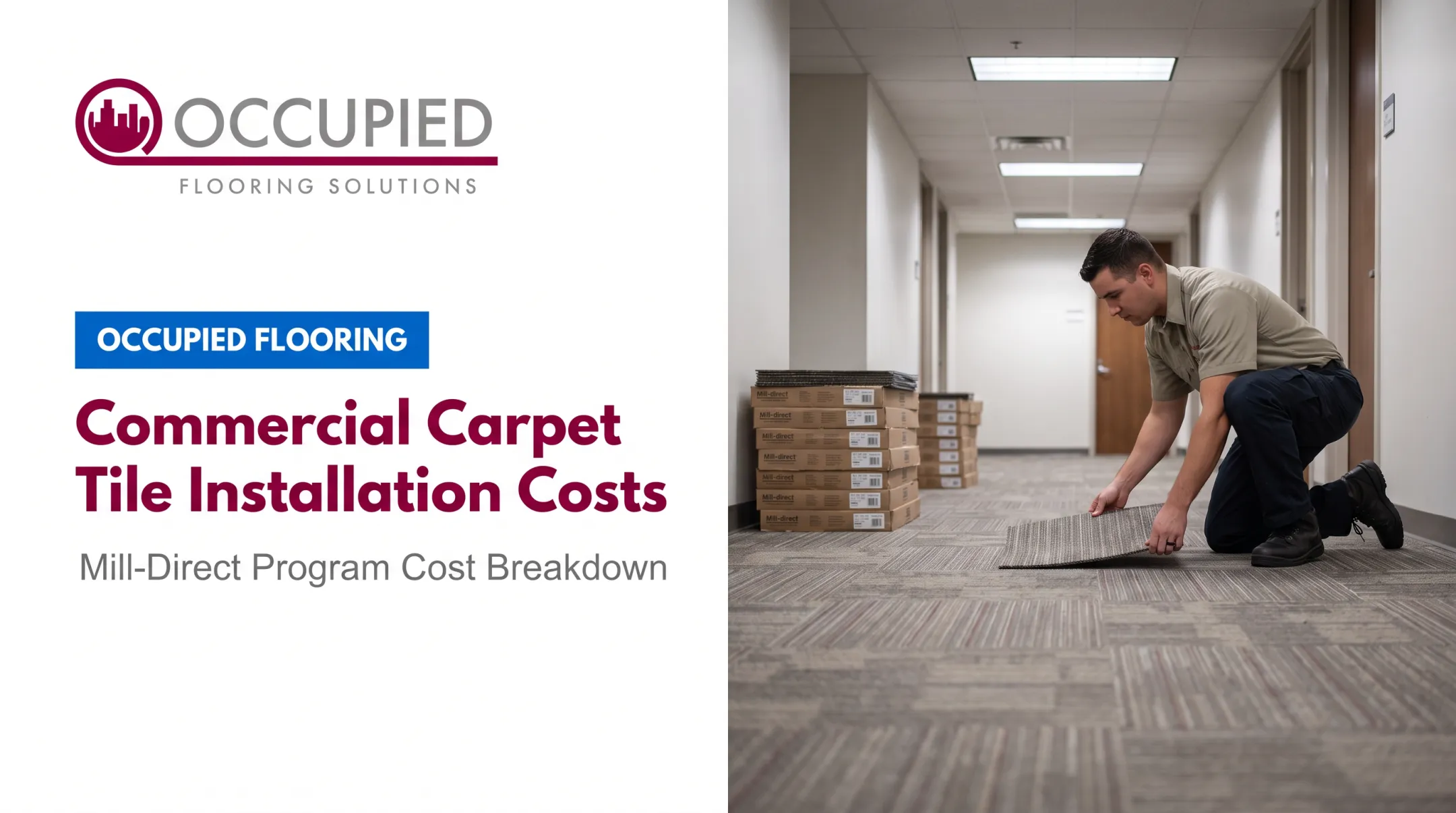

Commercial pricing behaves differently than residential work for several reasons:
- Higher-performance materials built for heavy foot traffic and commercial cleaning cycles
- Larger, often irregular floor plans that multiply labor hours
- Occupied facilities that require phased work instead of a one-day tear-out
- Furniture, systems furniture, and equipment that must be moved and reset
- Access restrictions like security clearances, elevator scheduling, or after-hours windows
This article breaks down current U.S. pricing ranges, the labor and material components behind them, sample budgets for common project sizes, lifecycle costs, and what a bid typically excludes.
Key Takeaways
- Material, subfloor condition, installation method, and site access each change per-square-foot price on their own.
- Split every budget into material-only, labor-only, and fully installed cost before you compare bids.
- Lower material price often brings more maintenance or a shorter replacement cycle.
- Build phasing, reporting, and security coordination into estimates for multi-site and occupied buildings.
How Much Does Commercial Flooring Installation Cost? (Pricing Overview)
There's no fixed national rate for commercial flooring. Prices swing based on the product line, the vendor, your region, and how much prep work the existing floor needs. The numbers below come from a 2024 Florida public-school district vendor schedule, one of the few publicly available sources that separates material cost from installation labor for the same specified products.
According to Lee County Schools' 2024 flooring vendor pricing, installed costs for common commercial materials break down like this:
| Flooring type | Material only ($/sq ft) | Labor only ($/sq ft) | Installed total ($/sq ft) |
|---|---|---|---|
| Broadloom carpet | 3.21–3.65 | 0.61–0.62 | 3.83–4.27 |
| Carpet tile | 3.11–5.00 | 0.51–0.64 | 3.61–5.64 |
| VCT (with 4 wax coats) | 2.27–2.95 | 1.70–2.57 | 4.65–4.84 |
| LVT (2.5mm–5mm) | 4.36–6.32 | 1.62–2.27 | 5.98–8.59 |
| Sheet vinyl | 5.11–5.55 | 2.92–3.20 | 8.03–8.75 |
| Ceramic tile | 4.02–9.17 | 4.60–7.67 | 8.62–16.31 |
| Rubber tile | 11.33–12.37 | 1.54–2.27 | 13.60–13.91 |

Two other benchmarks help fill out the picture. A 2023 industry lifecycle study models porcelain tile at roughly $11.38 per square foot installed for a typical office. A Chicago-area contractor reports polished concrete at $3–$6 per square foot in 2025, with staining adding $1–$3 more.
Three Practical Budget Tiers
- Basic: VCT or standard broadloom carpet, minimal substrate prep, standard-hours installation, manufacturer's base warranty.
- Standard: Carpet tile or 2.5mm LVT, moisture testing and light leveling included, 10-year commercial wear warranty typical.
- Premium: Ceramic/porcelain tile, rubber tile, or 5mm+ LVT with extended wear layers, full substrate remediation, and 15–20-year limited warranties.
Sample Project Budgets
Applying the Florida VCT and LVT rates above across three common project sizes shows how fast totals scale:
| Area | VCT ($4.65–$4.84/sq ft) | LVT ($5.98–$8.59/sq ft) |
|---|---|---|
| 500 sq ft | $2,325–$2,420 | $2,990–$4,295 |
| 1,000 sq ft | $4,650–$4,840 | $5,980–$8,590 |
| 2,000 sq ft | $9,300–$9,680 | $11,960–$17,180 |
These figures assume a prepared, ready-to-install floor. They don't include:
- Demolition or tear-out
- Moisture testing
- Wall base and transitions
- Furniture handling
- Taxes
- After-hours labor
Always confirm which of those items appear in a quoted range before comparing bids side by side.
Key Factors That Affect Commercial Flooring Costs
The visible flooring material is only one piece of the price. Technical specifications, site conditions, and scheduling constraints all shape the final number.
Type, Specification, and Performance Requirements
Wear layer thickness, backing system, slip resistance, and fire ratings all affect price before installation even starts.
A space that sees wet foot traffic, for example, generally needs a hard surface tested to ANSI A326.3 wet-DCOF standards. Corridors and exitways may need to meet ASTM E648 critical radiant flux requirements. The right spec depends on:
- Expected traffic volume and space function
- Cleaning and maintenance routines
- Regulatory or landlord-mandated performance standards
- Desired service life before replacement
Project Size, Layout, and Installation Pattern
Larger, open floor plates often reduce the per-square-foot rate because labor and material purchasing become more efficient. Small or fragmented spaces, by contrast, frequently carry minimum mobilization charges regardless of square footage.
Complex layouts push costs up further:
- Multiple rooms and corridors add cut lines and seams
- Stairs require separate labor rates and materials
- Diagonal, herringbone, or inlay patterns increase both labor time and waste
Existing Conditions and Preparation
What's underneath the new floor matters as much as what's on top. Removal of old flooring, adhesive scraping, moisture mitigation, and concrete leveling can all add significant line items.
Older buildings may also require asbestos testing before any disturbance, governed by EPA NESHAP rules and OSHA's Class II asbestos work standards for tile and adhesive removal. A 2022 New Hampshire state contract, in effect through March 2025, separately priced VCT preparation at $2.50 per square foot and carpet preparation at $4.00 per square yard, on top of the base material and labor.
Skipping a proper site assessment is one of the fastest ways to trigger a change order mid-project.
Installation Environment and Access
Active offices, hospitals, schools, and secure federal facilities rarely allow a standard daytime installation. These environments typically need:
- Phased, floor-by-floor or zone-by-zone execution
- Night, weekend, or after-hours labor
- Security escorts and restricted staging areas
- Elevator reservations and daily cleanup protocols
This is where a lot of first-time budgets fall short. At Occupied Flooring Solutions, projects in active government and commercial buildings are sequenced in micro-phases so workstations get lifted rather than fully dismantled, keeping electrical and IT systems live and spaces operational again by the next business day.
Materials, Procurement, and Lifecycle Value
Buying flooring one project at a time almost always costs more than buying it through a standardized catalog across multiple sites. Volume purchasing, approved product lists, and predictable freight and lead times all compress the price. Beyond the initial number, weigh:
- Maintenance frequency and cost over time
- Repairability of damaged sections
- Expected replacement cycle
- Disruption cost each time the floor is redone
Commercial Flooring Cost Breakdown: Budget vs. Premium
Two bids at the same per-square-foot price can cover completely different scopes. The only way to compare them fairly is line by line.
Initial Materials and Accessories
A complete material list goes beyond the flooring itself:
- Flooring product and adhesive
- Underlayment and moisture barriers
- Trims, reducers, and transitions
- Wall base and stair components
- Waste allowance (typically 5–10% depending on layout complexity)
Installation, Demolition, and Preparation
Installation labor should be broken out separately from prep and removal work. Bundling everything into one number makes it nearly impossible to catch what's missing:
- Removal, hauling, and disposal
- Adhesive removal and leveling
- Moisture remediation
- Furniture handling
Lower-Cost vs. Higher-Cost Choices
Upfront price only tells part of the story—durability and disruption change the real cost:
- VCT — low upfront cost, but needs regular waxing and shows wear faster in heavy traffic
- Carpet tile — easy spot replacement and moderate cost, with a shorter lifespan than hard surfaces
- LVT — higher upfront cost, better moisture resistance, and longer wear warranties (10–20 years by mil thickness)
- Ceramic/porcelain tile — highest upfront cost, longest service life, and minimal ongoing maintenance
Paying more upfront for a commercial-grade product, proper substrate prep, or an experienced occupied-facility crew often lowers total lifecycle cost. It also means fewer shutdowns that interrupt operations.
Recurring and Periodic Costs
Cleaning, periodic refinishing, spot repairs, and eventual full replacement all belong in a true budget picture.
A 2023 industry-funded lifecycle study of a typical office over 75 years makes the gap clear:
- VCT starts at $3.09 per square foot and climbs to a $159.48 net-present-value life-cycle cost
- Porcelain tile starts higher at $11.38 installed and settles near $73.16 over the same period, largely because it is replaced far less often

When you compare bids, weigh lifecycle cost and operational disruption—not just the day-one unit price.
How to Estimate the Right Commercial Flooring Budget—and Avoid Missed Costs
A reliable estimate follows a sequence, not a guess:
- Measure every area precisely, including odd corners and transitions.
- Classify use and traffic for each space, since a lobby and a back office need different specs.
- Select a performance specification based on traffic, moisture, and safety requirements.
- Inspect the existing floor for asbestos risk, moisture, and subfloor damage.
- Define phasing and access if the building stays occupied during work.
- Collect comparable bids using the same scope assumptions.
- Add a contingency, typically 10–15%, for conditions that surface once demolition starts.

Request an itemized proposal that separates material, labor, demolition, prep, accessories, testing, disposal, schedule assumptions, warranty terms, exclusions, and change-order rates. The lowest bid on paper often isn't the lowest total cost. Bids that omit substrate prep, adhesive removal, moisture testing, or occupied-space coordination shift those costs into change orders later.
Before signing, ask any installer:
- Have you completed comparable occupied-facility projects?
- What manufacturer certifications do your installers hold?
- How do you handle security clearances and after-hours access?
- What documentation and warranty support do you provide after completion?
Multi-site portfolios and buildings that must stay open need more than a one-off bid checklist. A standardized program keeps scope, pricing, and reporting consistent from property to property.
The National Flooring Program from Occupied Flooring Solutions uses preset labor pricing, a single point of contact, and portfolio-level dashboards for work orders, spend, SLAs, and warranties. It is not a guaranteed discount. It is a way to bring consistency to pricing and execution across a portfolio.
Cost-control strategies worth applying regardless of who installs your floor:
- Consolidate purchasing across sites to unlock volume pricing
- Standardize on an approved product list instead of specifying per project
- Phase work around occupancy instead of paying for emergency scheduling
- Choose repairable formats (like carpet tile) in high-wear zones
- Confirm substrate conditions before bidding, not after demolition starts
- Compare lifecycle cost, not just the material price per square foot
Conclusion
Commercial flooring installation costs depend on more than the product you choose. Material specification, labor, substrate preparation, site access, project scale, and operational requirements all factor into the final number. The right budget is built from a complete, itemized scope and lifecycle value, not the lowest advertised per-square-foot price.
Before committing to a vendor, get a site-specific assessment and compare written bids using the same scope assumptions. Whether you manage a facility, run contractor scopes, or oversee a multi-site portfolio, that upfront diligence is what keeps a flooring project on budget.
Frequently Asked Questions
What is the typical cost per square foot for commercial flooring?
Based on 2024 vendor data, VCT installs for $4.65–$4.84 per square foot and LVT for $5.98–$8.59, combining material and labor. Ceramic tile runs higher, from $8.62–$16.31 per square foot installed.
How much does it cost to install 500 square feet of commercial flooring?
Expect roughly $2,325–$2,420 for VCT or $2,990–$4,295 for LVT at this size. Smaller projects often carry minimum mobilization fees, so the per-square-foot rate may run higher than larger jobs.
How much does it cost to install 1,000 square feet of commercial flooring?
VCT runs approximately $4,650–$4,840, while LVT runs $5,980–$8,590 for the same area. These figures exclude demolition, prep, and accessories, which should be quoted separately.
How much does it cost to install 2,000 square feet of commercial flooring?
At 2,000 square feet, VCT costs roughly $9,300–$9,680 and LVT runs $11,960–$17,180. Larger areas can improve purchasing efficiency, but occupied or phased conditions can offset those savings.
How much does it cost to tile 1,000 square feet of commercial flooring?
Ceramic tile at this size runs approximately $8,620–$16,310 installed, based on 2024 vendor pricing. That range excludes demolition, disposal, grout upgrades, and substrate leveling, which are common add-ons for tile projects.
How much does 1,000 square feet of commercial vinyl flooring cost?
VCT costs about $4,650–$4,840, LVT runs $5,980–$8,590, and sheet vinyl runs $8,030–$8,750 for 1,000 square feet. The spread depends heavily on wear layer thickness and whether the subfloor needs leveling first.