
According to Angi's 2026 carpet installation guide, installed carpet in the US typically runs $3 to $11 per square foot, a range wide enough to cover a lot of ground.
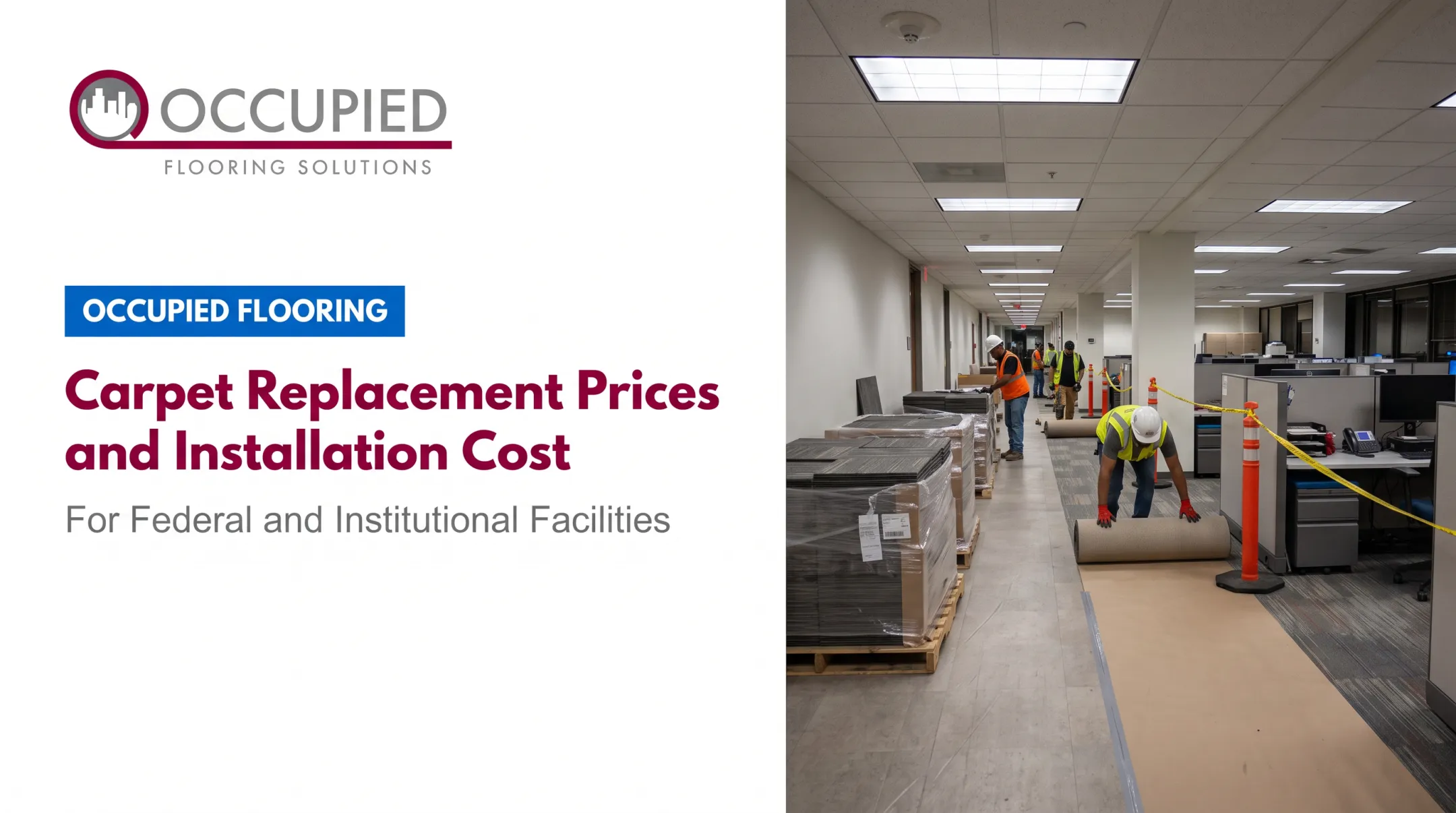
A simple residential bedroom costs far less than a large commercial buildout, and both look nothing like a phased carpet replacement inside an occupied federal building or hospital wing, where crews work around tenants, security protocols, and business hours.
This guide breaks down installed price ranges, common project-size estimates, the cost components behind every quote, and the budgeting steps that keep a project on track, plus the fees that catch buyers off guard.
Key Takeaways
- Installed carpet costs $3–$11 per square foot nationally in 2026 for carpet, pad, and basic labor.
- Removal, disposal, and subfloor repair usually sit outside that base installed range.
- Fiber, layout, padding grade, and site access swing price more than square footage alone.
- Small rooms and patterned layouts cost more per square foot than large, open installations.
- The lowest quote isn't always best value once durability, warranty, and disruption count.
How Much Does Carpet Installation Cost in 2026? (Pricing Overview)
Carpet installation is a variable-cost project, not a fixed-price purchase. The published $3-$11 per square foot range typically covers carpet material, basic padding, and standard installation labor. It commonly excludes:
- Old-carpet removal and disposal
- Furniture moving
- Subfloor repairs or leveling
- Stairs and specialty transitions
- Delivery fees and applicable taxes
Confirm what each bid bundles before you compare quotes. Two bids at the "same" price per square foot can cover very different scopes of work.
Typical pricing tiers
Not every installation fits into one bucket. Three tiers cover most residential and straightforward commercial jobs:
- Entry-level: Economical synthetic carpet (polyester or olefin) with standard padding in a simple, accessible layout.
- Mid-range: Durable mainstream fibers like nylon or triexta with average-quality padding, suited to standard offices, classrooms, and similar commercial rooms.
- Premium or complex: Premium fibers such as wool, upgraded cushion, pattern-matched carpet, stairs, extensive subfloor prep, difficult access, or phased work in occupied spaces.
There's no single "average" price across all three tiers. Material grade and site conditions push the same square footage in very different directions.
Common project-size examples
Using the $3-$11 per square foot range, common project sizes translate to:
| Project size | Square footage | Estimated installed cost |
|---|---|---|
| 12x12 room | 144 sq ft | $432-$1,584 |
| 20x20 room | 400 sq ft | $1,200-$4,400 |
| 700 sq ft space | 700 sq ft | $2,100-$7,700 |
| 1,000 sq ft space | 1,000 sq ft | $3,000-$11,000 |

These are straight-line calculations, not surveyed bids. Minimum job charges, waste allowance, padding upgrades, removal, and subfloor prep can push any of these totals higher.
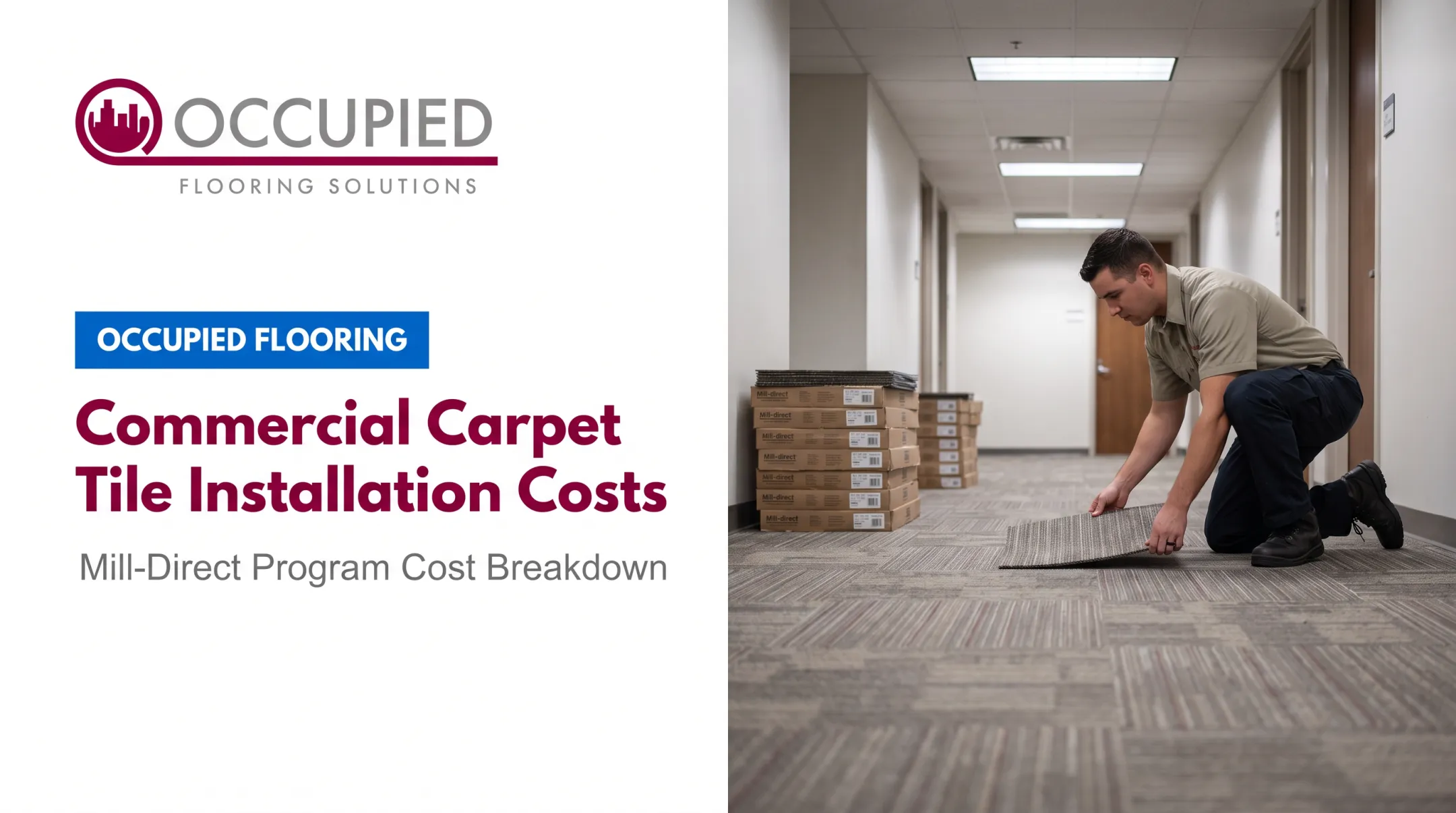
A single-room estimate also looks nothing like a larger commercial or portfolio project. Multi-site work introduces standardized materials, volume purchasing, phased access, and procurement requirements that change the effective rate, usually in the buyer's favor once enough square footage is involved.
Key Factors That Affect Carpet Installation Cost
Square footage is only the starting point. The final invoice reflects material selection, measurable area, site conditions, and operational requirements working together, not square footage alone.
Carpet fiber, construction, and quality
Fiber choice alone shifts material costs by a wide margin:
| Fiber | Material cost (per sq ft) | Best suited for |
|---|---|---|
| Polyester | $1-$3 | Budget residential, low traffic |
| Olefin/polypropylene | $1-$3 | Basements, budget applications |
| Nylon | $2-$5 | High-traffic homes, light commercial |
| Triexta | $3-$8 | Stain-prone areas, active households |
| Wool | $4-$20 | Premium residential, upscale offices |
These are material-only figures. Don't add them to an already-installed price range. Pile density, backing construction, pattern matching, and stain-resistance treatments also affect waste and labor time, not just the price tag on the roll.
Size, layout, and material waste
Rooms with closets, angles, or multiple seams need more carpet than a simple rectangle. Pattern matching adds further overage since dye lots and pattern repeats have to line up at every seam.
Small rooms often cost more per square foot than large ones. A minimum job charge and mobilization fee get spread across fewer square feet, while a continuous 2,000-square-foot installation dilutes those same fixed costs across a much bigger job.
Padding, subfloor, and preparation
Padding grade affects comfort, acoustic performance, and how long the carpet on top actually lasts. HomeAdvisor's 2026 padding pricing shows a wide spread by type:
| Padding type | Installed cost (per sq ft) |
|---|---|
| Rebonded foam | $0.75-$1.55 |
| Prime foam | $1.00-$2.25 |
| Fiber/jute/felt | $0.85-$2.00 |
| Frothed foam | $1.00-$2.75 |
| Flat rubber | $1.25-$3.75 |
Beyond padding, expect separate line items for site prep:
- Old-carpet removal: $1–$5 per sq ft, including disposal
- Subfloor repairs: about $600 on average for smaller fixes; more for extensive leveling
- Tack strip replacement and adhesive removal
In commercial or occupied buildings, budget for logistics as well:
- Furniture moving and systems-furniture handling
- Elevator access and security procedures
- After-hours labor where operations require it
Labor, location, and project conditions
Basic installation labor runs roughly $0.50 to $1 per square foot, according to This Old House's 2026 carpet cost breakdown, though rates vary by regional market and installer demand.
Specialized work costs more. Stair installation, for instance, commonly runs well above flat-rate room labor once per-step charges are factored in.
Commercial, federal, and institutional sites add another layer entirely. Coordination often includes:
- Security clearance and escort requirements
- Tenant notifications
- Infection-control protocols
- After-hours or weekend scheduling
A typical residential quote never accounts for that work. Programs built for occupied facilities, such as Occupied Flooring Solutions' phased, floor-by-floor lift-and-replace model, plan those requirements into labor, sequencing, and total project cost.

Low-Cost vs High-Cost Carpet Installation — What's the Difference?
A lower quote usually means basic materials, fewer preparation services, or a simpler scope. A higher quote often reflects durability, difficult site conditions, or more controlled execution. Neither is automatically the right choice; it depends on the space.
Performance and durability
Where each option holds up:
- Lower-cost builds: Economical synthetic carpet with standard cushion suits conference rooms, back-of-house areas, and other low-traffic zones. It shows wear sooner in corridors, lobbies, and high-traffic floors.
- Higher-cost builds: Denser construction, stronger fibers such as nylon or triexta, and better cushion last longer under heavy foot traffic.
Manufacturer warranties often track that gap—longer material and workmanship terms, plus limited installation-labor coverage on better-specified products. A longer warranty is not proof of longer service life by itself. It does show the manufacturer’s confidence in the product.
Installation quality and operational impact
A bargain quote can hide gaps: skipped subfloor prep, no coordination for occupied spaces, or a compressed schedule that rushes seams and transitions.
A higher-cost, better-documented installation typically includes:
- Detailed phasing plans and logistics staging
- Quality-control inspection at closeout
- Daily status reporting during multi-day work
- Return-to-service verification before crews leave
Occupied Flooring Solutions builds these steps into occupied-space projects so areas can return to full operation the next business day, without leftover punch-list work for facility staff.
Long-term value
The lowest bid rarely stays the cheapest option over time. Total cost of ownership includes more than today’s invoice:
- Replacement frequency
- Ongoing maintenance
- Operational disruption
- Warranty support
- End-of-life disposal
Those line items often outweigh a small gap between install quotes.
How to Estimate the Right Budget for Carpet Installation
Building a defensible budget starts with a simple sequence: measure the area, choose a performance level, price carpet and padding, add labor, then account for waste and preparation. Validate everything against an itemized quote before signing.
Build a project-specific estimate
A basic formula looks like this: Square footage × (material + padding + installation rate) + removal + disposal + repairs + transitions + stairs + furniture handling + taxes + contingency Take a 1,000-square-foot commercial space as an example. At the $3–$11 per square foot installed range, base carpet and labor cost $3,000–$11,000. Removal at $1–$5 per square foot adds $1,000–$5,000. Subfloor repairs (roughly $600 and up), furniture handling, and after-hours labor push the real project number well above the headline figure. Run the same formula for a 700-square-foot room, a 144-square-foot (12x12) room, or a 400-square-foot (20x20) space, and label every assumption clearly. Minimum job charges and waste allowances change small rooms the most.

Review commercial and occupied-space requirements
Facility and portfolio teams need to define several things before requesting bids:
- Phasing sequence and work hours
- Tenant or occupant notifications
- Security access and escort requirements
- Furniture or systems-furniture handling
- Elevator and loading dock access
- Infection-control protocols for healthcare settings
- Protection of adjacent finished areas
- Required closeout documentation Multi-site federal, institutional, and commercial programs need more than a room-by-room quote. Occupied Flooring Solutions' National Account Program gives portfolio teams one contract for:
- Standardized materials and preset labor pricing
- Phased occupied execution with certified installer coverage
- Work-order tracking, spend visibility, SLAs, and warranty reporting Single-room jobs rarely need that model. Teams running recurring flooring spend across many locations use it to cut site-by-site guesswork out of the budget.
Quote-comparison checklist and overlooked costs
Request itemized quotes, not lump-sum numbers. A solid quote specifies:
- Material specification and padding grade
- Waste allowance and seam plan
- Removal, disposal, and subfloor assumptions
- Furniture handling, stairs, and transition work
- Taxes, delivery, and warranty terms
- Schedule, payment terms, and change-order rules The cheapest quote often gets more expensive once it's missing preparation work, after-hours access, business-continuity measures, or repairs discovered after old carpet comes up. Compare multiple qualified bids line item by line item, not just by the headline per-square-foot number.
Conclusion
Carpet installation cost in 2026 adds up from several line items:
- Fiber type and construction
- Padding grade and measured area
- Labor rates, subfloor prep, and site access
- Overall project complexity
Whether the job is a commercial suite or a phased replacement across an occupied federal building, an accurate budget starts with a transparent, itemized scope.
Lowest bid price is only one input. Stronger budgets weigh upfront cost against durability, installation quality, warranty support, and how much disruption the work causes to daily operations.
For federal facility managers, institutional portfolio owners, or commercial teams handling occupied or multi-site flooring needs, Occupied Flooring Solutions offers a project-specific assessment to map out phasing, budget, and execution before work begins.
Frequently Asked Questions
What is the average cost to install a carpet?
Installed carpet in the US typically runs $3 to $11 per square foot in 2026, covering carpet, basic padding, and standard labor. Removal, disposal, and subfloor prep usually cost extra.
How much does it cost to install 1,000 square feet of carpet?
At the standard $3–$11 per square foot range, 1,000 square feet costs roughly $3,000–$11,000 installed. Material grade, waste, removal, and commercial access or phasing requirements can push the total higher.
How much is 700 square feet of carpet?
A 700-square-foot installation runs approximately $2,100–$7,700 at standard rates. That range is installed cost—material-only pricing is lower and excludes labor, padding, and prep.
What is the average cost to carpet a 12x12 room?
A 12x12 room (144 square feet) typically costs $432–$1,584 installed. Minimum job charges, padding upgrades, furniture moving, and removal can raise that total noticeably for such a small area.
How much would it cost to carpet a 20x20 room?
A 20x20 room (400 square feet) runs roughly $1,200–$4,400 installed. A simple open room like this costs far less per square foot to install than a phased, occupied commercial floor with access and continuity constraints.