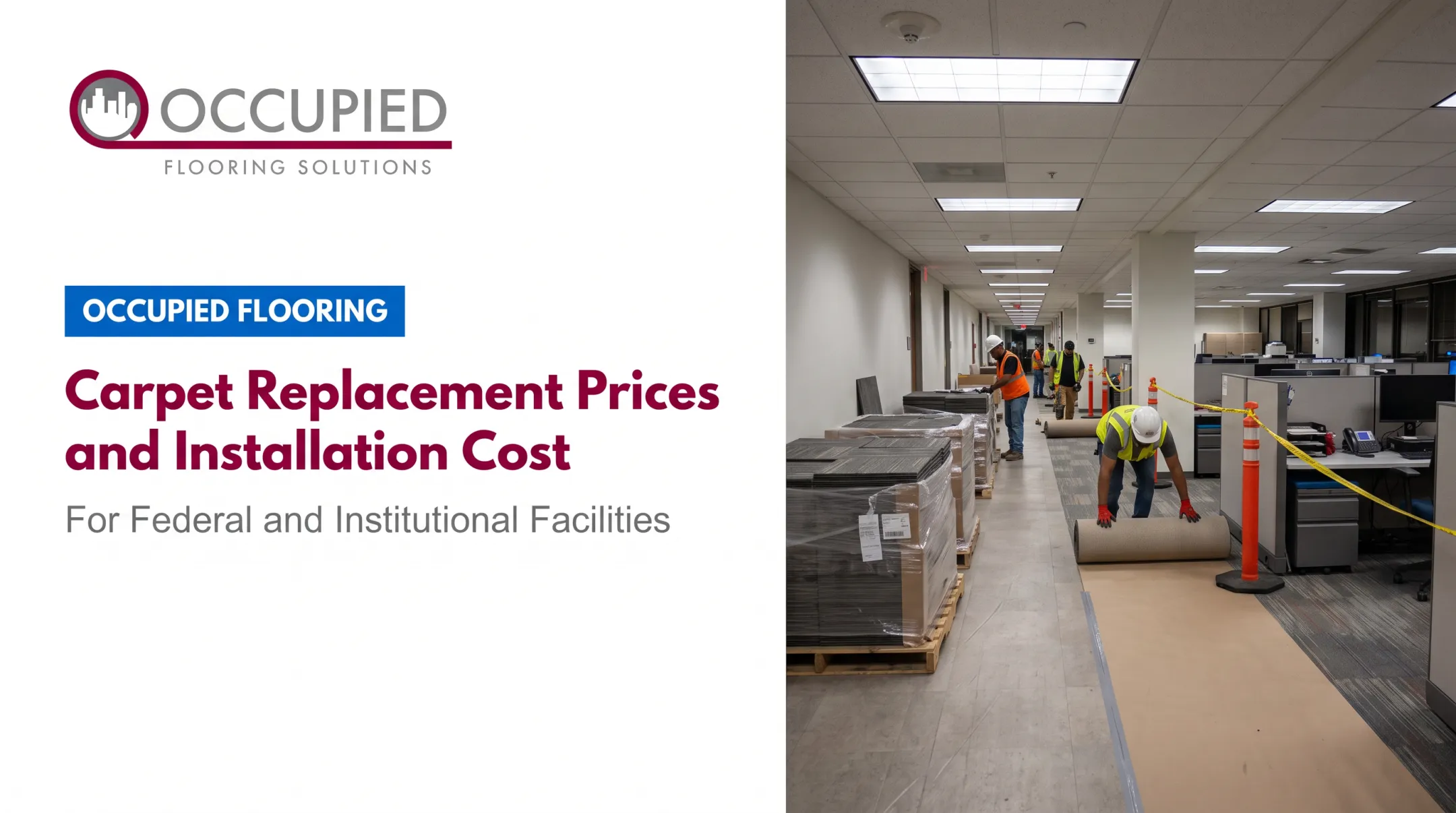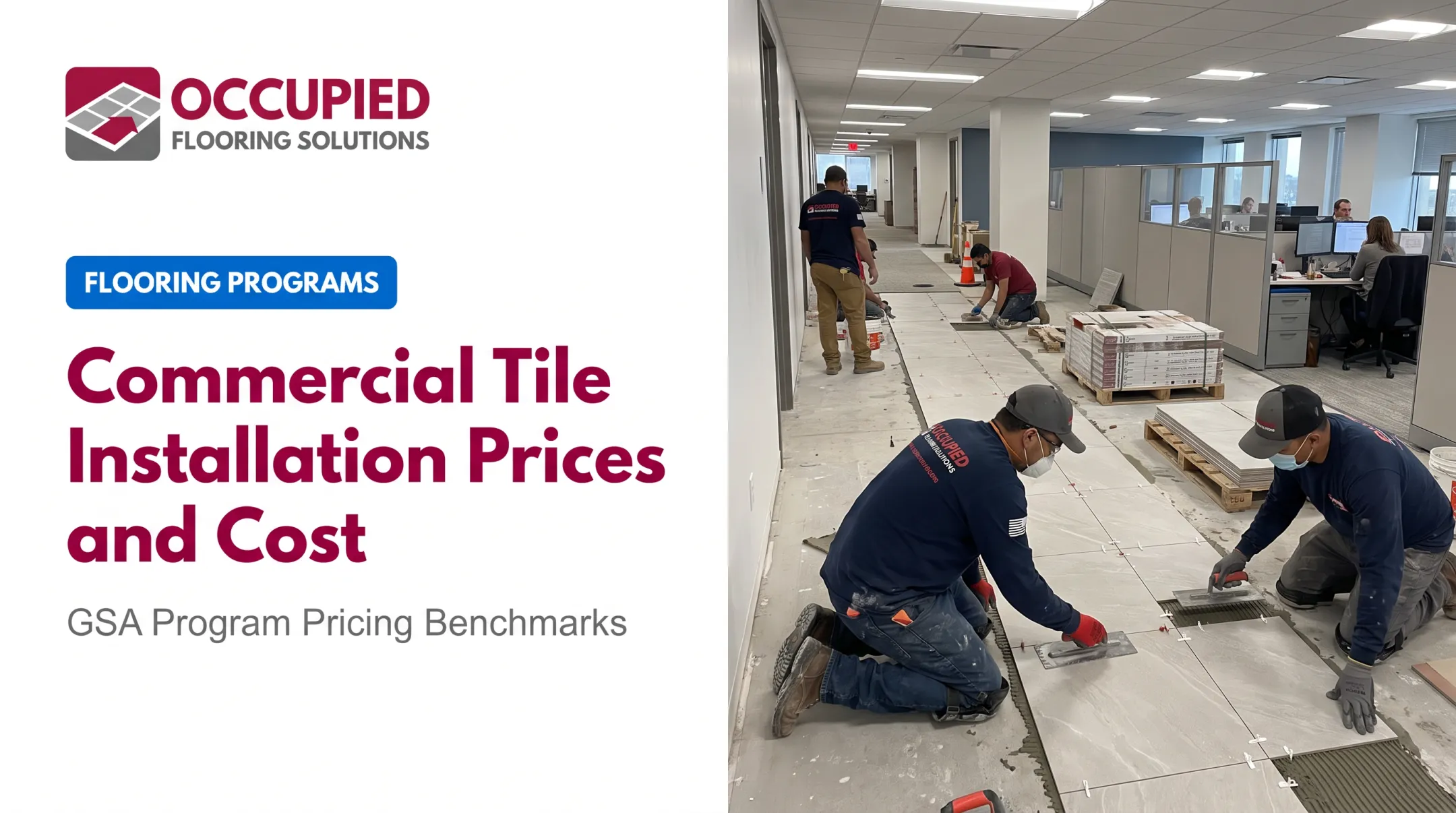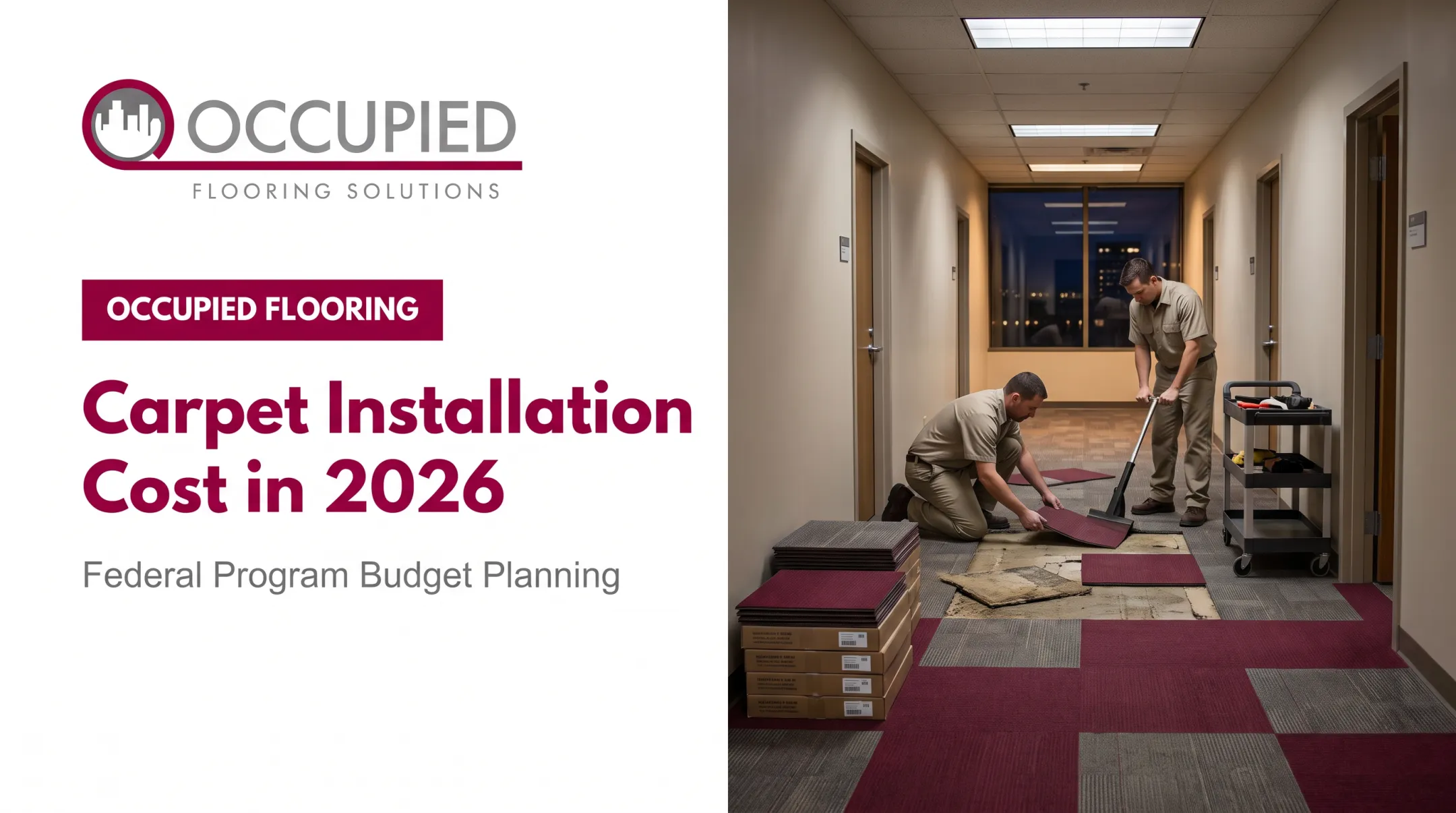

Pricing for an occupied building looks nothing like pricing for a vacant space. Occupied projects involve phasing around tenants, coordinating systems furniture, working around access restrictions, scheduling after-hours crews, and protecting business operations while work happens around employees still at their desks.
This guide breaks down current U.S. commercial pricing considerations, the material and labor components that drive cost, low-cost versus premium specification choices, and a practical method for evaluating installation quotes before you sign anything.
Key Takeaways
- Material-only, labor-only, and fully installed rates differ—no single national price fits every project
- Construction, backing, subfloor condition, site access, and scale move final cost up or down
- Small, complex, occupied, or security-controlled jobs often cost more per square foot
- Lowest quote is rarely lowest total cost once durability, downtime, and warranty matter
How Much Does Commercial Carpet Tile Installation Cost? (Pricing Overview)
There's no single national price for commercial carpet tile installation right now. Manufacturer pricing has shifted meaningfully in recent years. Interface, for instance, raised U.S. carpet tile prices by 5% to 7% in 2021, alongside a separate 10% increase on adhesive. Older price lists and catalogs from a few years back can't be treated as current bids.
A properly scoped installed quote should include:
- Carpet tile material, adhesive or tackifier, and transition strips
- Layout, cutting, and installation labor
- Basic cleanup and waste disposal
- Freight and applicable taxes
It should exclude, or price as separate alternates:
- Existing floor removal and adhesive scraping
- Subfloor leveling, crack repair, or moisture mitigation
- Furniture or systems-furniture handling
- After-hours or weekend labor premiums
Typical Cost Range
Commercial carpet tile generally falls into three specification tiers. Exact dollars should still come from a location- and product-specific quote:
- Entry-level / basic: Standard-color, non-patterned tiles in a clear, vacant space; simple loop construction and standard backing
- Mid-range / standard: Commercial-grade nylon for offices and institutional corridors with moderate-to-heavy traffic
- High-end / advanced: Premium fiber, acoustic or moisture-management backing, custom patterning, or occupied/phased install logistics
A dated but useful reference point: a Shaw Contract government price schedule showed product-only prices from roughly $16.81 for a value-tier tile to $58.42 for a premium pattern. That schedule was published in April 2020, and its contract expired in March 2023. Treat the spread as proof of how far product tiers can diverge, not as a current quote.
To turn a current rate into a project budget:
- Multiply measured square footage by the material-only or installed rate for your exact product
- Add separately priced items: subfloor prep, removal, freight, mobilization, and taxes
- For a 1,000-square-foot space, request low, typical, and high quotes on the same spec, then layer prep and logistics as distinct line items

Small projects often carry minimum mobilization or project-management charges, so the effective per-square-foot rate runs higher than on a large rollout.
Key Factors That Affect the Cost of Commercial Carpet Tile Installation
Commercial pricing reflects technical specification, labor conditions, building operations, and project risk—not the tile sticker price alone.
Tile Type, Fiber, Backing, and Performance Specification
Fiber choice changes both cost and expected performance:
- Nylon: Dominant commercial fiber per the Carpet and Rug Institute; strong abrasion resistance and durability
- Olefin/polypropylene: Moisture- and chemical-resistant option, often at a lower price point
- Polyester: Strong colorfastness; better for lower-traffic areas than heavy-traffic corridors
Backing systems add another cost layer. PVC-free backings, moisture-management systems, attached cushion, and enhanced acoustic (IIC-rated) assemblies each carry different price points by manufacturer construction.
Fire performance matters too. Commercial floor coverings are tested to ASTM E648 or the equivalent NFPA 253 radiant-flux standard. Confirm your required classification on the product data sheet—do not assume it from fiber type alone.
Project Size, Layout, Waste, and Design Complexity
Larger, repeatable floor areas typically reduce the effective labor and mobilization rate per square foot. Small rooms, irregular boundaries, multiple buildings, and complex transitions increase both labor hours and material waste.
Design choices compound this:
- Directional patterns require more precise cutting and higher waste allowances
- Custom color sequencing slows takeoff and installation time
- Tile size affects how efficiently a room can be covered without excess cuts
Interface notes that waste can run as little as 1.5% for its non-directional i2 styles. That figure is product-specific, not an industry standard—request a layout-specific waste calculation for your chosen tile.
Existing Floor, Removal, and Subfloor Preparation
Before any tile goes down, the subfloor has to meet manufacturer requirements. The CRI 104 installation standard calls for documented concrete moisture and alkalinity testing within manufacturer limits, removal or encapsulation of old adhesive, and patching of cracks or depressions.
These items are frequently priced separately from tile placement:
- Existing carpet removal and disposal
- Adhesive scraping or encapsulation
- Moisture emission or relative humidity testing
- Leveling compound and crack repair
Ask your contractor to state explicitly which of these conditions is excluded from the base installed price — concealed subfloor issues are one of the most common sources of change orders.
Occupied-Space and Commercial Logistics
This is where costs diverge most sharply from a textbook installation. Occupied-space work involves:
- Moving or lifting systems furniture and cubicles instead of dismantling them
- Protecting occupants, equipment, and live electrical/IT systems during work
- Phased room-by-room or floor-by-floor turnover
- Dust, noise, and pathway controls during business hours
At Occupied Flooring Solutions, this logistics layer is built into the delivery model rather than treated as an afterthought. Workstations are lifted, not dismantled, and electrical and IT systems stay live throughout the work.
Spaces return fully operational the next business day. That sequencing depends on detailed phasing plans that define exactly which zone is worked and when.
Facilities with restricted access, badging requirements, or escort protocols add another layer. No universal dollar premium exists for night work, weekend scheduling, or federal security coordination; price these as project-specific alternates.

Occupied Flooring Solutions handles escort coordination and access controls directly for secure, escort-required federal facilities—unlike a standard vacant-office install.
Labor, Region, Procurement, and Project Administration
Regional labor markets, freight costs, and delivery constraints all move pricing. Prevailing-wage or union requirements, where applicable, are contract- and jurisdiction-specific — the solicitation or contract should identify which labor basis applies before bids come in.
Multi-site portfolios add administrative cost beyond field labor: standardized specifications, centralized ordering, work-order tracking, and warranty documentation across every property. Occupied Flooring Solutions' National Flooring Program addresses this with set pricing for multi-site deployments and volume-based negotiated rates, rather than renegotiating terms at every location.
Cost Breakdown of Commercial Carpet Tile Installation and Low-Cost vs High-Cost Options
A credible commercial budget separates direct flooring costs from preparation, logistics, and lifecycle considerations. Here's how the major cost categories typically break down:
| Cost Category | One-Time / Recurring | What It Covers |
|---|---|---|
| Initial material purchase | One-time, with future replacement purchases | Carpet tile, backing, adhesive, transitions, freight, taxes, waste allowance, spare inventory |
| Installation, supervision, site logistics | One-time per phase; phased projects may repeat mobilization | Layout, cutting, installation, cleanup, supervision, furniture coordination, after-hours labor |
| Preparation, removal, disposal, repairs | One-time, unless concealed conditions arise | Old flooring removal, adhesive removal, substrate repair, moisture mitigation, disposal |
Low-Cost Commercial Carpet Tile
A budget specification typically includes:
- Standard colors and simpler layouts
- Entry-level fiber and backing
- Installation in an accessible, vacant space with minimal prep
The trade-off shows up later: shorter appearance retention, less durable backing, and thinner warranty coverage.
Higher-Cost Commercial Carpet Tile
A premium specification typically adds:
- More resilient fiber
- Upgraded acoustic or moisture-management backing
- Custom patterns and spare-inventory reserves
- Detailed closeout documentation
For occupied or phased work, this tier usually includes stronger warranty provisions and more rigorous performance testing.
Lifecycle cost hinges on durability, ease of localized replacement, disruption during future maintenance, and suitability for continuous high-traffic use. A facility running three shifts a day has different math than a quiet back office. Match the specification to actual use, not just the budget line.
How to Estimate the Right Budget for Commercial Carpet Tile Installation — and What Most Buyers Miss
Start by measuring each area separately, not the building as a whole. Record:
- Room type and square footage for each space
- Corridor lengths and transitions between materials
- Existing flooring type and condition
- Access restrictions, occupancy status, and required completion dates
Then request itemized quotes that separate material, waste, labor, removal, disposal, subfloor prep, furniture handling, mobilization, project management, freight, taxes, and warranty terms.
Comparing bids only works when the specifications match: same fiber, same backing, same tile size, same pattern direction, and same adhesive system.
Commonly missed costs include:
- Spare tiles for future localized repairs
- Color-lot consistency across phases
- Delivery storage if site access is restricted
- Security badging or escort requirements
- After-hours labor premiums
- Final closeout documentation and warranty registration
For occupied facilities, factor in downtime, tenant disruption, and schedule slippage, not just the contractor's invoice. A lower bid that stretches a project from two weeks to six because of poor phasing can cost more in lost productivity than a higher, better-sequenced bid.

Occupied Flooring Solutions focuses on that occupied-cost gap. It runs controlled flooring programs with phased execution, standardized materials, national program administration, preset labor pricing, and portfolio-level reporting.
For teams weighing single-site quotes against multi-site program pricing, that model shows total program cost against your real scope and site count.
Conclusion
Commercial carpet tile installation costs vary with product specification, floor preparation, project scale, labor conditions, and whether the work happens in an occupied facility. Approve a number only after a detailed, site-specific scope—not before.
The right budget balances installed cost against durability, replacement strategy, business continuity, and long-term portfolio control. A cheaper quote that ignores subfloor conditions or occupied-space logistics tends to get expensive fast once work actually starts.
Facility, property, and portfolio teams planning occupied or multi-site U.S. flooring work need that scope walk-through before they lock a price. Occupied Flooring Solutions can walk through what a controlled occupied program actually costs across your portfolio.
Frequently Asked Questions
How much does it cost to install carpet tile per square foot?
There is no single verified national rate for 2026. Price moves with product spec, region, and site conditions, so request an itemized quote that separates material, labor, and preparation.
What is the typical cost of carpet tiles per square foot?
Material-only pricing tracks fiber, backing, and design complexity. Installed cost is higher once labor and prep are included—always confirm which figure a quote is using before you compare suppliers.
How much does it cost to install 1,000 sq ft of carpet tile?
Multiply your quoted installed rate by 1,000, then add removal, subfloor repair, freight, taxes, and any occupied-space premiums priced separately. Build low/typical/high scenarios from your actual product spec, not a generic average.
Are carpet tiles cheaper than traditional carpet?
Carpet tile usually wastes less during install and lets you replace damaged modules instead of full runs. Broadloom can win on upfront material price, but total cost favors the format that fits your traffic, layout, and maintenance plan.
How much do 2x2 carpet squares cost?
A 24-inch by 24-inch tile covers 4 square feet, so unit price converts directly from the per-square-foot rate. Final cost still hinges on fiber, backing, pattern, and how complex the install is on your site.
How many carpet tiles do I need for a 12x12 room?
A 12-by-12 area is 144 square feet—36 tiles at 4 square feet each for exact coverage. Add a waste factor for cuts and pattern matching, plus attic stock for future repairs on commercial floors.