
Introduction
Replacing carpet in an occupied facility is disruptive enough without discovering, three years in, that you specified the wrong grade for a given zone.
The right commercial carpet grade shapes appearance retention, replacement cycles, and daily maintenance load. It also determines how visible the difference is between a lobby and a back-office corridor.
Grade selection isn't about buying the highest-rated product available. It depends on traffic volume, wheeled loads, business use, your maintenance program, and installation conditions.
The Carpet and Rug Institute's commercial maintenance standard recommends daily attention for lobbies and elevator cabs, but only two to three vacuuming sessions per week for private offices. That single detail explains why one carpet grade rarely fits an entire building.
This guide breaks down commercial carpet grades by zone, what the ratings mean in practice, and how to match product to traffic without overbuying.
Key Takeaways
- Commercial carpet grades describe expected traffic intensity, not overall product quality
- Match grade to actual zone use — corridors, lobbies, and entrances need different specs than private offices
- Review TARR data, fiber, density, backing, fire performance, and warranty terms together, not in isolation
- Compare lifecycle cost and installation disruption, not just sticker price, especially in occupied buildings
What Are Commercial Carpet Grades?
A commercial carpet grade signals the traffic intensity a product is engineered to handle in a business environment. Treat it as a planning label rather than a guaranteed performance score. Manufacturers, specification systems, and industry bodies don't all use identical terminology, which is exactly why a grade name should never be the only thing on your purchase order.
Before approving anything, pull the technical documentation: test results, warranty language, and installation requirements. The grade tells you what the product is designed for. The paperwork tells you whether it actually performs.
Types of Commercial Carpet Grades
Most US commercial carpet falls into four broad categories, based on the CRI's traffic-level guidelines:
| Traffic level | Typical spaces |
|---|---|
| Light | Private offices, conference rooms, retail dressing rooms, exam rooms |
| Moderate | Healthcare corridors, patient rooms, meeting rooms, retail sales floors |
| Heavy | Office elevator lobbies, high-rise entrances, retail checkouts, regional airport terminals |
| Extra-heavy | Emergency-room lobbies, public concourses, main building entrances |
Here's the part that trips up a lot of buyers: a single facility usually needs several grades, not one. Picture a multi-tenant office building. The private offices along the perimeter see light foot traffic and almost no wheeled loads beyond an occasional office chair.
The main lobby, by contrast, absorbs daily deliveries, wet umbrellas, rolling luggage from visiting clients, and steady foot traffic from every tenant on every floor. Specifying the same carpet for both wastes money in the offices and guarantees premature wear at the entrance.
Performance Specifications Behind the Grade
The grade name is shorthand. The performance data behind it is where the real decision happens.
TARR (Texture Appearance Retention Rating) measures how much a carpet's surface visibly changes under simulated foot traffic. Under CRI Test Method 103, samples go through 12,000 rotations in a hexapod drum tester, then get scored against reference images on a scale from 5 (no visible change) to 1 (severe change).
Ask for the actual report on the specific product you're considering. Skip generic industry claims.
Face weight isn't the same thing as density, and treating them as interchangeable is one of the most common specification mistakes.
- Face weight measures ounces of pile yarn per square yard
- Density accounts for pile yarn weight relative to pile height (thicker pile with the same face weight is actually less dense)
- Construction and fiber type determine how the carpet responds to crushing, matting, and repeated traffic
A carpet with a heavier face weight but low density and a tall pile height can wear worse than a lighter, denser product. Request density figures alongside face weight before assuming "heavier equals more durable."

Benefits of Matching Grade to Application
Getting the grade right per zone pays off in ways that show up months and years later, not on installation day.
Under-specifying creates predictable problems:
- Visible traffic lanes and crushing within the first year or two
- Premature replacement, often before the warranty period even ends
- Warranty disputes when appearance loss exceeds what the product was rated to handle
Over-specifying carries its own cost:
- Unnecessary upfront spend on performance the space will never demand
- Fewer design and texture options, since extra-heavy-traffic constructions tend to be more limited
- Budget that could have gone toward better carpet in the zones that actually need it
Matching grade to application protects appearance retention, keeps maintenance predictable, supports acoustic comfort in open workspaces, and stretches the replacement cycle as far as the space allows.
What to Consider When Choosing the Best Commercial Carpet Grade
Treat this as a room-by-room framework, not a building-wide decision. Walk each zone separately and assess it against these factors before finalizing a spec.
Traffic Volume and Traffic Type
Volume matters, but traffic type often matters more. A corridor with steady foot traffic behaves differently than an entrance handling rolling carts, luggage, and wet or gritty debris tracked in from outside.
Assess each zone for:
- Pedestrian volume and peak-use periods
- Wheeled traffic — office chairs, carts, equipment, luggage
- Moisture and soil exposure near entrances and loading areas
These factors drive appearance retention, cleaning frequency, repair cycles, and how fast the floor looks worn to occupants and tenants.

Fiber, Density, Pile Construction, and Backing
Common commercial fibers each bring different tradeoffs:
- Nylon: Durable, abrasion-resistant, and strong under wet cleaning; the usual choice for heavy commercial use
- Solution-dyed nylon: Nylon durability plus stronger fade and colorfastness performance
- Olefin/polypropylene: Resists moisture and chemical staining; common where spills are frequent
- Polyester/PET: Solid stain resistance for lighter commercial traffic; less pile durability under heavy loads
Backing matters just as much as face fiber. Ask manufacturers directly about tuft bind strength, delamination resistance, moisture management, and seam performance. Don't accept generic marketing claims — request the actual product data sheet.
TARR, Testing, and Safety Documentation
Beyond TARR, confirm the product was tested for the conditions your space actually presents. ASTM uses separate methods for general appearance change (tumble drum) and caster-chair wear (roller-chair tester).
If the zone sees rolling office chairs daily, request roller-chair test data, not only a general appearance-retention score.
Also confirm:
- Fire performance documentation appropriate to your occupancy and adopted building code
- Colorfastness data for high-light or high-soil environments
- Any project-specific requirements from your architect, GSA lease, or local code official
Different bodies (ASTM, CRI, ISO, EN) use different methods. Confirm any rating cited actually applies to your US project before relying on it.
Carpet Format and Installation Method
| Factor | Broadloom | Modular tile |
|---|---|---|
| Visual field | Continuous; no grid | Visible seams; more design options |
| Damage repair | Larger patch or full replacement | Swap individual tiles |
| Attic stock | Standard practice | Often required; some lines reduce need |
| Installation speed | Faster in large open areas | Faster around obstacles and furniture |
Installation planning should also cover:
- Systems furniture and workstations already in place
- Subfloor prep, adhesives, and moisture conditions
- Whether operations must continue during the work (phased or after-hours occupied replacement)
Maintenance, Appearance, and Total Cost of Ownership
Match the grade to your real maintenance capacity: staffing, equipment, vacuuming frequency, and whether spot-cleaning and periodic deep-cleaning are actually in place. A high-grade carpet without that program rarely outperforms a moderate grade that is maintained on schedule.
Compare total cost of ownership, not just the per-yard material price:
- Material and installation cost
- Maintenance labor and equipment over the expected service life
- Repair and localized replacement cost
- Disposal and removal at end of life
- Business downtime during replacement
A Procurement Checklist for Comparing Products
Before approving any commercial carpet spec, confirm you have:
- Intended-use classification and traffic assumptions for the specific zone
- Fiber type, construction, density, and pile height data
- TARR (or equivalent) report specific to the product
- Backing, tuft bind, and delamination resistance documentation
- Fire performance and code-compliance paperwork
- Warranty terms, including exclusions
- Maintenance requirements and recommended schedule
- Lead times, attic stock availability, and installer qualifications
Request physical samples and technical data sheets, and get a zone-by-zone recommendation in writing before sign-off—especially on multi-site or GSA-leased work where specs, attic stock, and occupied phasing need to stay consistent.
How Occupied Flooring Solutions Can Help
Choosing the right grade solves half the problem. Installing it without shutting down a working building or a federal facility is the other half — and it's where most flooring projects run into trouble.
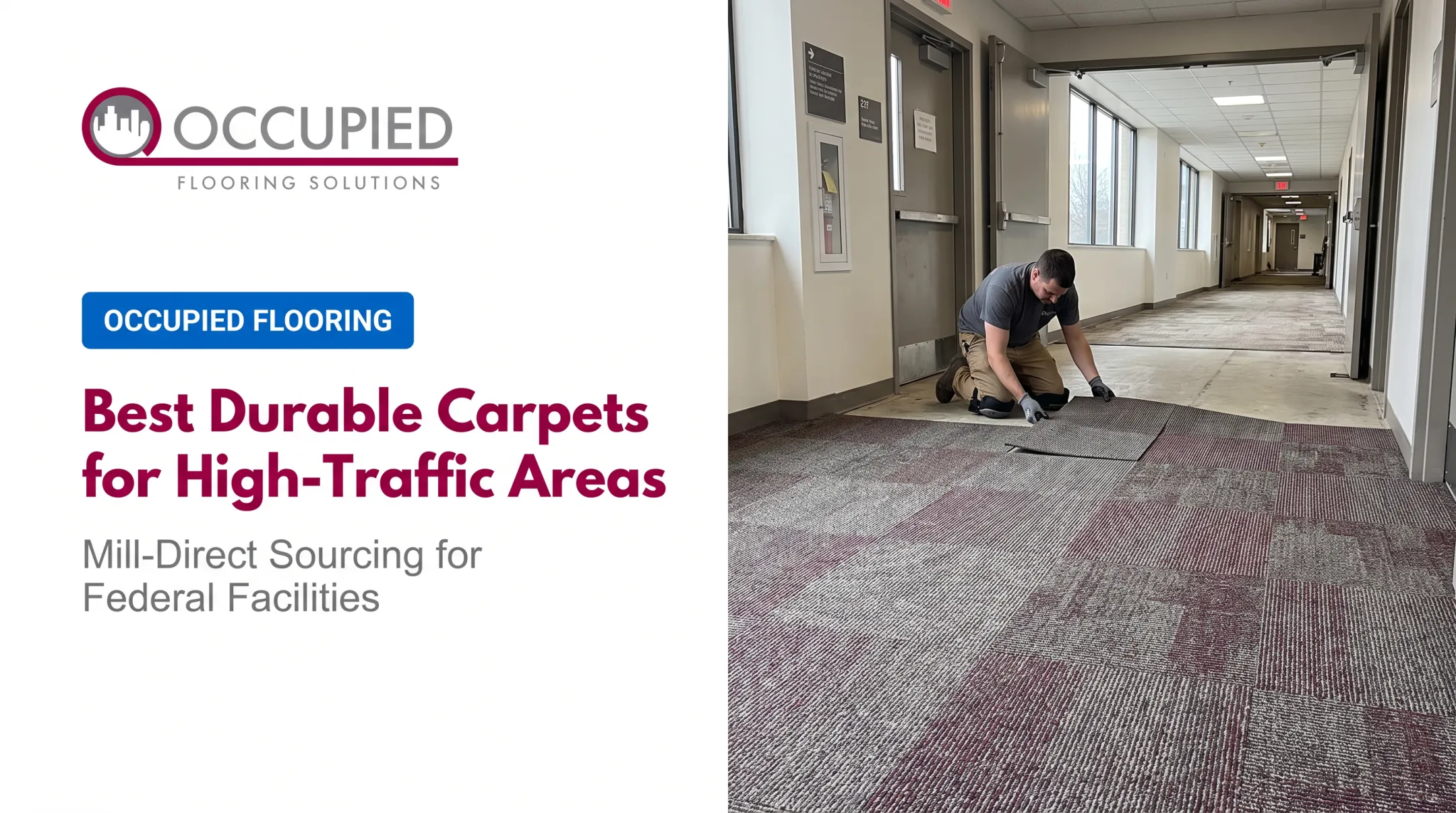
Occupied Flooring Solutions manages controlled flooring and interior-surface renovations for federal agencies, GSA-leased properties, and mission-critical commercial portfolios across the country. When carpet replacement can't be treated like a vacant-space job, that distinction matters.
Our occupied-space approach supports:
- Phased, floor-by-floor or zone-by-zone execution that works around tenants, systems furniture, and live electrical and IT systems instead of dismantling them
- After-hours and weekend scheduling so daily operations continue uninterrupted
- Security-cleared, escort-required site access for federal and GSA environments
- Next-business-day operational restoration after each phase of work
That occupied-space discipline works differently once you're managing five properties instead of one. Our National Account Program gives portfolio teams:
- One point of contact and standardized execution across every region
- Pre-approved materials and preset labor pricing that remove regional cost guesswork
- Certified installer coverage spanning all 50 states
- Live dashboards tracking work orders, spend, SLAs, warranties, and documentation property-by-property
With 1,230+ completed projects and more than 15 million square feet installed nationwide, we've built our process around one constraint most flooring vendors don't plan for. The building has to keep running. If you're managing multi-site or occupied flooring programs, request a portfolio assessment to see how a standardized approach fits your facilities.

Conclusion
There is no single best commercial carpet grade. The right grade matches each zone's traffic, performance needs, maintenance capacity, and budget. A lobby and a private office in the same building often need different specifications, and no amount of upfront cost fixes that mismatch.
Don't choose on appearance, face weight, or the word "commercial" on a spec sheet alone. Weigh each zone against:
- Traffic level and expected wear
- Performance and durability requirements
- Maintenance capacity and cleaning schedule
- Full lifecycle budget, not unit price alone
Technical documentation and installation planning carry equal weight in the decision.
After install, keep reviewing the floor. Maintenance records, appearance checks, and repair history sharpen the next replacement cycle and make future budgets more predictable.
Frequently Asked Questions
What makes a carpet commercial grade?
Commercial-grade carpet is designed and tested for public or business environments, with construction, backing, and appearance-retention performance matched to expected traffic. The label alone isn't proof. Check the test documentation and warranty terms too.
What are the different categories of carpet grades?
Categories typically run light, moderate, heavy, and extra-heavy. Light suits private offices and conference rooms; extra-heavy fits airport concourses and building entrances handling constant foot and wheeled traffic.
Which commercial grade carpet is the best?
There's no universally best grade. The right choice matches the zone's traffic type, your maintenance plan, tested performance data, and your lifecycle budget. No single "top-tier" product fits every space.
How do I choose the right commercial carpet grade for my business?
Assess each zone's foot and wheeled traffic, business use, maintenance resources, and installation conditions separately. Then compare total cost of ownership, not just material price, across compliant options.
Is carpet density more important than face weight?
Neither should be reviewed alone. Density, pile height, fiber type, construction, and tested appearance retention all need to be considered together before judging durability.
Are carpet tiles or broadloom better for commercial spaces?
Tiles allow selective replacement of damaged areas and often generate less installation waste. Broadloom offers a continuous, seamless appearance. The better format depends on your design goals, subfloor access, and repair needs.